

The short answer
Multifamily charging is a parking, power, and policy system
The charger is the visible part. The project also needs a repeatable way to assign spaces, recover electricity costs, approve resident requests, manage electrical demand, support drivers, and add ports as adoption grows.
| Model | Best fit | Planning questions |
|---|---|---|
| Assigned charger | Deeded or long-term assigned parking | Who owns equipment, pays installation and electricity, and handles moves or resale? |
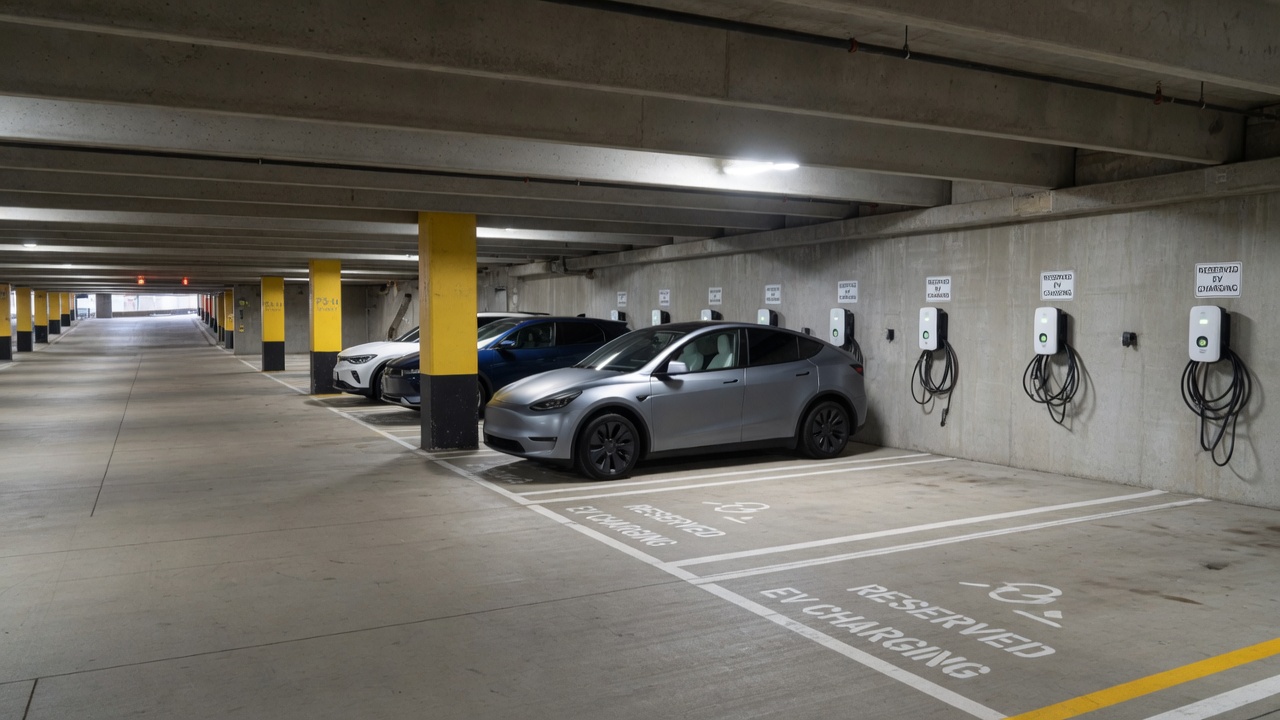
| Shared resident charging | Buildings with flexible parking or a smaller first phase | How are sessions scheduled, spaces enforced, and idle vehicles managed? |
| Public or mixed-use charging | Properties serving residents plus guests or nearby drivers | What hours, pricing, access, signage, insurance, and support are appropriate? |
| EV-capable first phase | New construction or renovations preparing for future demand | Which conduit, panel space, and managed capacity will avoid expensive rework? |
What Chicago condo boards, landlords, and developers should know about Illinois law
The Illinois Electric Vehicle Charging Act addresses both construction readiness and requests to install chargers. It does not eliminate design, safety, insurance, cost-allocation, or approval requirements.
Condo and common-interest communities
Association rules generally may not prohibit or unreasonably restrict a charging system in a unit owner’s designated parking space. Reasonable restrictions may still apply. If approval is required, the association must process the request, provide a written decision, and—under the statute—an application not denied in writing within 60 days can be deemed approved unless a reasonable request for more information caused the delay.
The law also assigns responsibilities involving installation, electricity, maintenance, damage, insurance, and disclosure. An association can install shared charging in a common area and establish terms of use.
Renters
The state’s rules also address a renter installing Level 1 or Level 2 charging in an allotted parking space. A landlord may impose allowed conditions involving electricity reimbursement, networking fees, restoration, wiring or electrical upgrades, licensed installation, and insurance. The exact statute and lease should be reviewed before a project proceeds.
New and renovated residential properties
State law includes EV-capable parking requirements for new single-family, small multifamily, and large multifamily construction, with additional rules and exceptions. The U.S. Department of Energy’s Illinois summary says new or renovated large multifamily dwellings generally must make all parking spaces EV-capable. For qualifying affordable developments, a 40% EV-capable benchmark begins in 2026, with later increases.
Chicago’s zoning requirements are a separate layer
For qualifying new household-living projects whose first building-permit application was submitted on or after November 1, 2023, Chicago’s zoning code generally requires 100% of accessory parking spaces serving dwelling units to be EVSE-ready or EVSE-installed. The code uses 20% requirements for several other parking categories, including accessory spaces serving other uses and non-accessory parking. Group-living, lodging, and nonresidential projects follow their own thresholds and dates.
These are not interchangeable with the state’s “EV-capable” requirements. A project team should check both layers and determine which definition—EV-capable, EV-ready, or EVSE-installed—applies to each space.
Before relying on a percentage
Confirm the building type, affordable-housing status, permit date, scope of renovation, local amendments, and statutory exceptions with the project’s design team, legal counsel, and code officials.
Plan the electrical backbone for more than today’s first requests
Giving every future space its own full-capacity circuit can be impractical in an existing building. Giving no thought to future spaces can make every new resident request a custom construction project. A better plan often combines:
- A documented assessment of service, panels, transformers, and peak building load
- A target for ports now, EV-capable spaces later, and the pathway between them
- Dynamic or scheduled load management where appropriate
- Conduit routes and equipment locations that minimize repeated wall and pavement work
- A fair rule for allocating limited capacity as requests grow
Load management can allow a group of chargers to share available capacity and prioritize energy over the hours vehicles are parked. The design still needs professional review and must comply with applicable electrical and building requirements.
Decide billing and operations before residents plug in
A multifamily project needs clear ownership for both money and uptime. Put the answers in writing:
Cost recovery
Will residents pay actual energy, a session fee, a subscription, installation cost, or a documented combination?
Access
Who can use each port, how are users authenticated, and what happens when a vehicle remains after charging?
Support
Who receives alerts, answers driver questions, maintains connectivity, and dispatches repairs?
Networked charging can support user authentication and session reporting, but it also introduces subscriptions, connectivity needs, payment rules, and a vendor relationship that should be evaluated before purchase.
A practical checklist for the board or property team
- Survey residents without overbuilding from a single response.
Ask about current EV ownership, next-vehicle plans, parking assignment, commute, and preferred access model.
- Map parking rights and operating rules.
Identify deeded, assigned, shared, accessible, visitor, and public spaces before locating equipment.
- Assess power and construction paths.
Document existing capacity, likely panel locations, conduit routes, connectivity, and expansion constraints.
- Adopt a consistent request policy.
Define application information, review timing, installer and insurance requirements, payment, maintenance, removal, and transfer responsibilities.
- Compare ownership models.
Consider resident-owned, association-owned, third-party-operated, or mixed systems against the property’s staffing and financial goals.
- Build the first phase around a clear second phase.
Reserve the pathway and management strategy that will let the property grow without starting over.
A plan residents can understand
Turn individual requests into a property-wide charging strategy.
Welsh Global Energy helps Chicago and Chicagoland multifamily teams assess parking, power, equipment, and phased installation needs. Legal and code questions should be confirmed by the property’s professional advisers.
Official sources
- Illinois General Assembly — Electric Vehicle Charging Act
- Illinois General Assembly — Section 30, unit-owner charging policy
- U.S. Department of Energy AFDC — Illinois residential EV-capable building standards
- U.S. Department of Energy AFDC — Illinois charger policies for owners and renters
- Chicago Zoning Ordinance §17-10-1011 — EVSE-ready parking
- Chicago Zoning Ordinance — EVSE definitions
This guide is educational and not legal, engineering, tax, or property-management advice. Consult the current statute, local code officials, qualified counsel, and licensed professionals for a specific property.